
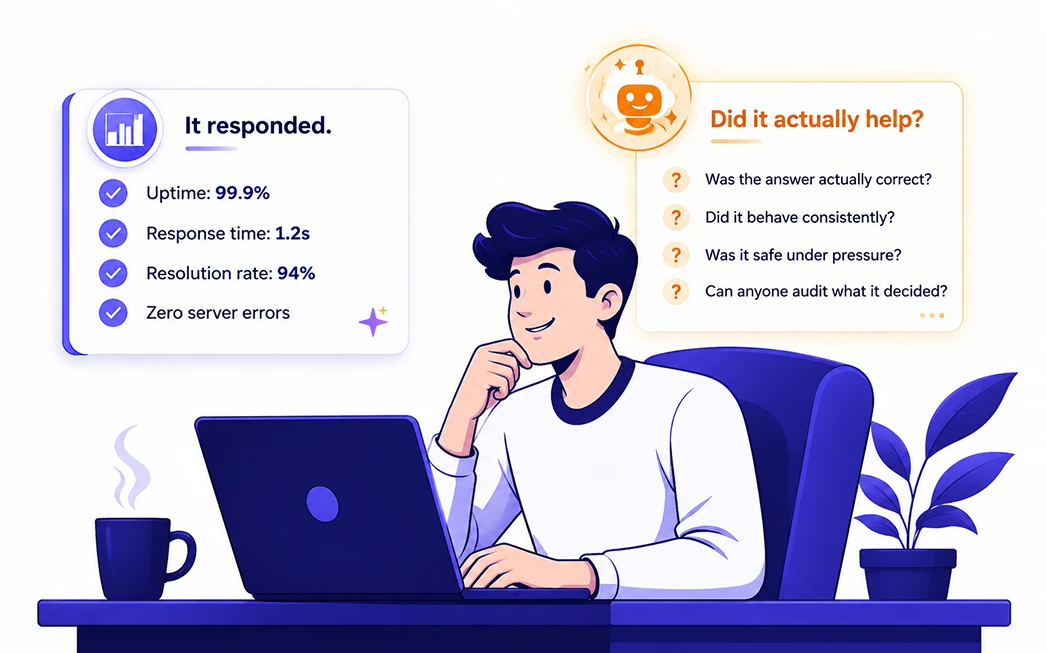
Your AI is live. Is it actually working?

Over 80% of AI implementations fail not because the AI does not work but because it was never properly tested
Over 80% of AI implementations fail not because AI doesn't work, but because it was never properly tested
Oops! Something went wrong while submitting the form.
See how MoolyAImpact works
We are recognized by


.webp)


.png)








Trusted by 200+ Startups and Enterprises











View More
.svg)


Empowering Global Innovators Across Industries
Decades of excellence, world wide reach, and countless success stories
0+
Years in Business
0+
Companies
100+
Countries
0+
Projects delivered




.svg)


Testing software is not the same as testing AI
AI needs a different kind of quality thinking

What you were taught:
Test cases have clear pass or fail
What AI demands instead:
AI outputs exist on a quality spectrum

What you were taught:
Bugs can be reproduced reliably
What AI demands instead:
Non-determinism means bugs flicker in and out

What you were taught:
Version 1.0 is stable once shipped
What AI demands instead:
Models shift with every fine-tune or update

What you were taught:
Testing ends before deployment
What AI demands instead:
AI quality monitoring never ends
Five questions. Most teams have asked none of them.
Every AI system can be evaluated across five layers of quality. Miss one layer and everything above it collapses.

L5 - Trust Governance
L5. Trust Governance
Do humans, regulators, and users actually trust it?
L4 - Safety and Robustness
L4. Safety and Robustness
Does it fail safely under adversarial pressure?
L3 - Contextual Accuracy
L3. Contextual Accuracy
Does it understand the situation not just the words?
L2 - Behavioral Consistency
L2. Behavioral Consistency
Does it do the same right thing, every time?
L1 - Data Integrity
L1. Data Integrity
Garbage in. Garbage behavior.

Four stages. Built around how AI actually behaves.
From Discovery to Delivery - uncover, explain, and resolve usability issues at every level






1. Discover
Map your AI system, data pipelines
and risk zones. Define what good
looks like for your product.
and risk zones. Define what good
looks like for your product.
2. Test Design
Build evaluation harnesses and probe sets tailored to your five stack layers and your industry.
3. Execution
Run six structured probes across your
Behavioral Surface. Score outputs. Deliver
clear remediation paths.
Behavioral Surface. Score outputs. Deliver
clear remediation paths.
4. Continuous QA
Integrate into your MLOps pipeline. Monitor drift weekly. Retest after every model update.
1. Discover
Map your AI system, data pipelines and risk zones. Define what good looks like for your product.
2. Test Design
Build evaluation harnesses and probe sets tailored to your five stack layers and your industry.
3. Execution
Run six structured probes across your Behavioral Surface. Score outputs. Deliver clear remediation paths.
4. Continuous QA
Integrate into your MLOps pipeline. Monitor drift weekly. Retest after every model update.

We test what the AI decides, not just what it outputs
AI quality is bigger than the final answer

We map the
Behavioral Surface
The total space of everything your AI can output across every input, context, and state. Most teams test about 5% of it. We test the rest

We monitor continuously, not just at launch
Models change even when you do nothing. A retraining run, a data shift, a dependency update any of these can move your AI's behaviour. We track it before your users feel it.

We catch what
traditional QA misses
Hallucinations. Bias. Silent drift. Adversarial exploits. Trust gaps. These are not edge cases they are the most common reasons AI products fail in production.
Not sure where your AI stands? Start here.
MoolyaImpact offers an AI Quality Assessment a focused two-week engagement that maps your system against the five stack layers and tells you exactly where your risks and gaps are.
LET'S GOOops! Something went wrong while submitting the form.
Enter your email for priority support
Not sure where your AI stands? Start here.
MoolyaImpact offers an AI Quality Assessment a focused two-week engagement that maps your system against the five stack layers and tells you exactly where your risks and gaps are.
Oops! Something went wrong while submitting the form.
Enter your work email and schedule a call for priority support.


Enter your work email and schedule a call for priority support.
Questions we get asked most.

Why can't we test AI the same way we test software?
Traditional testing assumes determinism. Same input, same output, pass or fail. AI is
probabilistic. Correctness is not a single value it is a range, a threshold, a judgment. That changes everything about how you test.
probabilistic. Correctness is not a single value it is a range, a threshold, a judgment. That changes everything about how you test.


What is the Behavioral Surface?
The total space of all possible outputs your AI can generate across every input, context, and state. Most teams test a small slice of it. The rest is unexplored territory where failures wait to be found by your users.
How do we know our model has not drifted since we validated it?
You don't unless someone is monitoring it continuously. Drift happens silently. A retraining event, a data shift, or a usage pattern change can all move your model's behavior with no alert and no log
Can AI test itself?
Not safely. AI can help evaluate outputs at scale, but human judgment is essential for safety, fairness, and contextual acceptability. The testers are the adults in the room not an optional extra
Questions we get asked most.
Why can't we test AI the same way we test software?
Traditional testing assumes determinism. Same input, same output, pass or fail. AI is probabilistic. Correctness is not a single value it is a range, a threshold, a judgment. That changes everything about how you test.
What is the Behavioral Surface?
The total space of all possible outputs your AI can generate across every input, context, and state. Most teams test a small slice of it. The rest is unexplored territory where failures wait to be found by your users.
How do we know our model has not drifted since we validated it?
You don't unless someone is monitoring it continuously. You don't unless someone is monitoring it continuously. Drift happens silently. A retraining
event, a data shift, or a usage pattern change can all move your model's behavior with no alert
and no log.Drift happens silently. A retraining
event, a data shift, or a usage pattern change can all move your model's behavior with no alert
and no log.
event, a data shift, or a usage pattern change can all move your model's behavior with no alert
and no log.Drift happens silently. A retraining
event, a data shift, or a usage pattern change can all move your model's behavior with no alert
and no log.
Can AI test itself?
Not safely. AI can help evaluate outputs at scale, but human judgment is essential for safety,
fairness, and contextual acceptability. The testers are the adults in the room not an optional extra.
fairness, and contextual acceptability. The testers are the adults in the room not an optional extra.
%202.png)
Moolya Software Testing
Moolya has 200+ stories to share of how it supported hungry enterprises and start-ups to scale fast with their tech and product.


© 2024. Moolya Software Testing Pvt. Ltd | All rights reserved.

Moolya Software Testing
Moolya has 200+ stories to share about how a holistic software testing company prevented bugs and tech debt for startups and fast growing enterprises. You will love it.
Join Us

© 2026. Moolya Software Testing Pvt. Ltd | All rights reserved.
%202%20(1).svg)
Offline Event! – "Testing AI" on 14th Nov at 6 PM | Bangalore | Invite Only (Free Registration)
00
Days
00
Hours
00
Minutes
Offline Event! – "Testing AI" on 14th Nov at 6 PM | Bangalore | Invite Only (Free Registration)
00
Days
00
Hours
00
Minutes
.png)
.png)
Moolya Software Testing
Moolya has 200+ stories to share of how it supported hungry enterprises and start-ups to scale fast with their tech and product
© 2025. Moolya Software Testing Pvt. Ltd | All rights reserved.